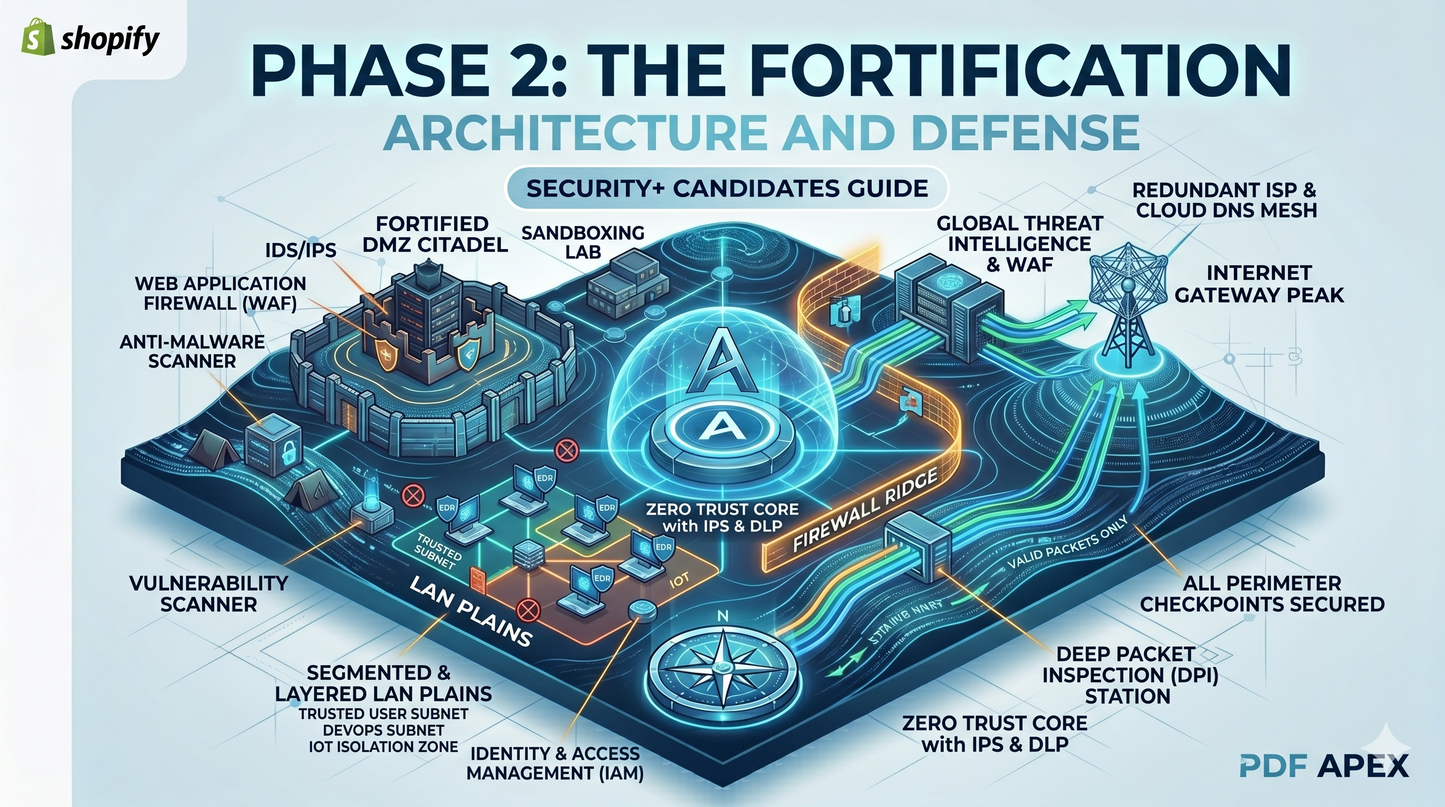
Phase 2: The Fortification: Architecture and Defense
Phase 2: The Fortification: Architecture and Defense
Couldn't load pickup availability
Now that you know how the adversary breaks in, it’s time to play architect.
In Phase 1, we dissected the enemy's playbook and analyzed how threat actors pick logical locks, weaponize social psychology, and slip malware into volatile system memory strings. Now, our role shifts entirely. Our explicit goal is to construct multi-layered logical fortresses, write foolproof permission systems, and roll out network architectures so robust that attackers will bypass your environment out of sheer frustration.
If you are an IT professional or a CompTIA Security+ candidate tired of trying to absorb dry, unfeeling, 800-page textbooks that hide basic security concepts behind dense engineering math, welcome to your structural blueprint.
Phase 2: The Fortification is an unabridged, high-volume digital guide engineered to completely demystify Domain 2.0 (Architecture and Design). Written in plain, straightforward English, this manual breaks down enterprise defenses into clear, scannable frameworks that anyone can master.
🗺️ What's Inside the Fortification Blueprint:
-
Section 1: Perimeter Defense & Network Architecture Layers – Stop relying on single-point perimeters. Master the Defense-in-Depth "Onion Framework" and learn the exact structural differences between basic port-checking Stateless Firewalls, dynamic Stateful Firewalls, Layer-7 Web Application Firewalls (WAFs), and Forward vs. Reverse Traffic Proxies.
-
Section 2: Networking Protocols & Infrastructure Hardening – Build a protocol mapping matrix to entirely decommission insecure legacy clear-text communication channels. Swap vulnerable streams for cryptographically armored alternatives (
TelnettoSSH,HTTPtoHTTPS, andFTPtoSFTP) and master isolation boundaries via VLAN segmentation. -
Section 3: Remote Access & VPN Tunnel Workflows – Secure your remote perimeters safely. This section breaks down the configuration trade-offs, operational impacts, and traffic flows of Full Tunneling vs. Split Tunneling VPN architectures, paired with the deployment logic of hardened Jump Boxes and Bastion Hosts.
-
Section 4: Cryptography Foundations (Math Without Tears) – Skip the complex linear algebra. We deliver a straightforward guide to Symmetric vs. Asymmetric Encryption, Block vs. Stream ciphers, and one-way Hashing algorithms (
SHA-256) for data integrity. Learn the exact mechanics behind password salting, Rainbow Table blockades, and the Public Key Infrastructure (PKI) ecosystem. -
Section 5: Identity & Access Management (IAM) Models – Establish unbreakable identity validation checklines. Master the 5 Factors of Authentication (from something you know to something you do) and structurally evaluate enterprise access control models, including
RBAC,ABAC,MAC, andDAC. -
Section 6: High Availability, Redundancy, & System Resilience – Ensure your architecture stays completely turned on and fault-tolerant. Demystify Active-Active vs. Active-Passive load balancing layouts, map out full
RAIDdisk arrays (0, 1, 5, 6, 10), deploy the definitive 3-2-1 Backup Strategy, and track standard resilience targets (MTBF,MTTR,RTO, andRPO). -
Section 7: Cloud Deployment Models & Infrastructure as Code (IaC) – Navigate modern distributed cloud spaces. Learn the operational differences between
SaaS,PaaS, andIaaSservice tiers using our straightforward "Dine-In, Delivery, or Frozen Store Pizza" comparison. Plus, master automated script setups viaIaCtemplates to eliminate configuration drift and human clicking error. -
Section 8: DevSecOps Pipelines & Secure Coding Gaps – Bridge the siloed operational gap between software developers and security tools. Learn how automated pipelines audit application files using Static Application Security Testing (SAST) vs. Dynamic Application Security Testing (DAST) checks, and lock down secure input validation and generic error handling habits.
🧠 High-Recall Sticky Mnemonics Included:
-
DiD = Defense is Deep (Layered enterprise friction).
-
SAME = Symmetric Always Matches Everywhere (Single shared secret key).
-
RBAC = Role Binds Access Controls (Title-based user group authorization).
-
SNMPv3 = Secure Network Management Protection version 3 (Modern monitoring standard).
-
CIA = Confidentiality, Integrity, Availability (The absolute holy trinity of cyber governance).