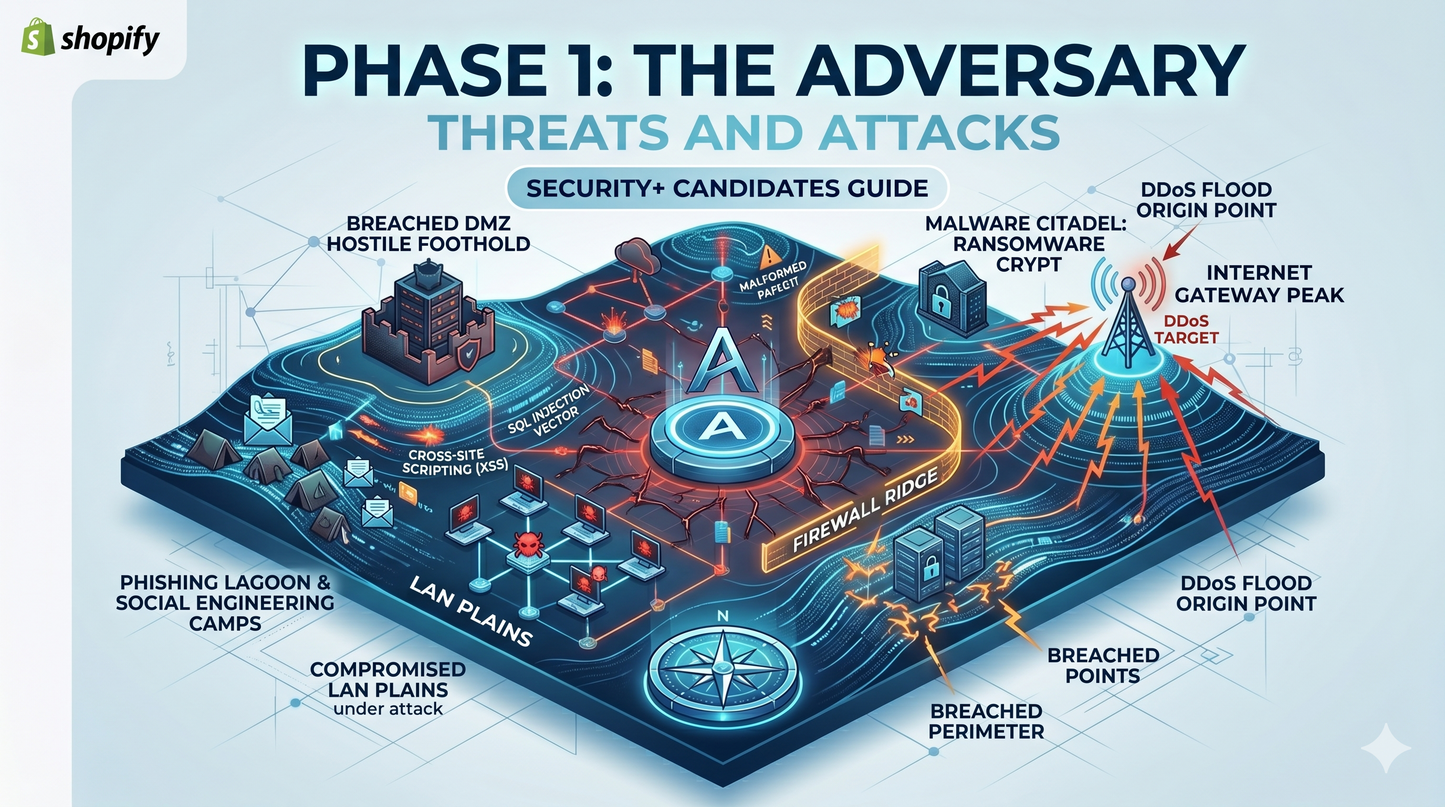
Phase 1: The Adversary: Threats and Attacks
Phase 1: The Adversary: Threats and Attacks
Couldn't load pickup availability
Before you can stop a digital thief, you have to look at your network through their eyes.
If you are an IT professional or a CompTIA Security+ candidate tired of trying to absorb dry, unfeeling, 800-page textbooks that make simple threats sound like alien rocket science, welcome to your operational briefing.
Phase 1: The Adversary is an unabridged, high-yield digital manual engineered to completely demystify Domain 1.0 (Threats, Attacks, and Vulnerabilities). We strip away the complex, over-engineered academic fluff and replace it with direct, plain-English frameworks, memorable memory shortcuts, and realistic defense humor.
By the end of this blueprint, you won't just blindly memorize terms for an exam sheet—you will actually understand the exact mechanisms threat actors use to breach networks well enough to explain them to a high schooler (or your non-technical boss).
📋 What's Inside the Adversary Blueprint:
-
Section 1: Threat Actors, Vectors, & Intelligence Frameworks – Get a complete technical profile of the enemy. Master the differences between nation-state cyber-ninjas (APTs), low-skilled script copy-pasters, and rogue shadow IT databases. Learn to decode attack vectors and read threat intel feeds (
STIX/TAXIIandCVE/NVD) fluently. -
Section 2: Social Engineering & Behavioral Triggers – Explore the "human aquarium". Learn how attackers drop specialized traps like Spear Phishing, Whaling, and AI-powered Vishing. Master physical security vectors like Tailgating vs. Piggybacking and look at the exact psychological principles used to manipulate human logic.
-
Section 3: Malware Architecture & Indicators of Compromise (IoCs) – A comprehensive guide to software written with a bad attitude. We cover double-extortion ransomware, autonomous network worms, invisible rootkits, and hidden logic bombs. Learn how modern hackers bypass file signatures using fileless malware ("Living off the Land") and how to hunt down threat footprints via network beacons and registry drift.
-
Section 4: Network, Wireless, & Infrastructure Attacks – Learn how adversaries disrupt availability and intercept packets. We break down state-table SYN floods, asymmetric DNS reflection amplification math, local ARP cache poisoning, and the distinct mechanics of Rogue Access Points vs. Evil Twins.
-
Section 5: Application Layer Exploits & Log Analysis – Dive straight into input-handling code flaws. This section delivers clear breakdowns of SQL Injection (
SQLi), Cross-Site Scripting (XSS), and memory buffer overflows. Includes real-world server log analysis exercises so you can spot relative path directory traversals (../) instantly. -
Section 6: Tactical Vulnerability Assessment & Scanning Modes – Understand how to audit your environment before the adversary does. We compare routine Vulnerability Management to active, authorized Penetration Testing simulations, and map out the exact trade-offs of Credentialed vs. Non-Credentialed automated scanning paths.
🧠 High-Recall Sticky Mnemonics Included:
-
APT = Always Planout Timelines (State-sponsored groups with infinite patience).
-
SK = Siply Koping (Script kiddies who blindly paste tools they don't understand).
-
Piggybacking has two Gs for the Good Guy who politely compromises security.
-
Worm = Without Warning (Autonomous network replication).
-
XSS = Xecuting Scripts on Students (Browser-based data theft).